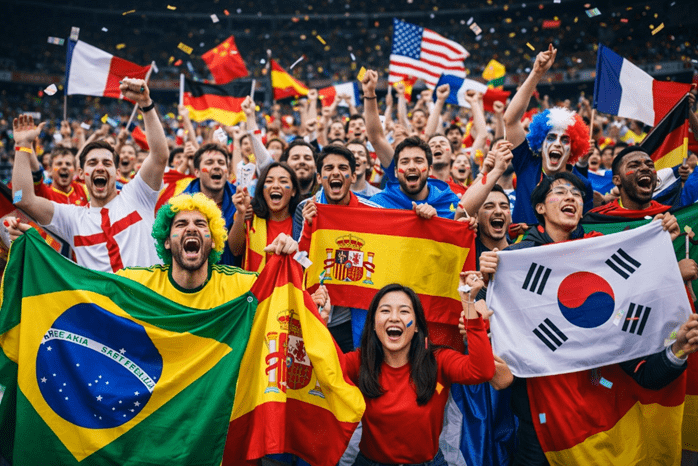
Sports translation in the World Cup Sports translation enables international tournaments to become global spectacles, bringing people from different cultures and backgrounds together. For example, at events such as the FIFA World Cup, fans from around the world come together to share their passion for the sport, despite speaking different languages. Sports translation enables audiences around the world to follow the same matches, teams and stories in real time, whether through official broadcasts or social media posts. In this way, sports translation plays a vital role in breaking down cultural and linguistic barriers, turning soccer into a truly global experience. The global reach of soccer Sports translation is essential for expanding the global reach of soccer. International tournaments attract viewers from all over the world, creating a high demand for multilingual media content. As a result, international soccer events become more accessible, thus reinforcing the sport’s position as one of the most globalized. Cultural differences in language and sports translation The translation of sports terminology is complex and dynamic because sports terms are described differently across languages. Distinct expressions, tones and styles are used when discussing sport, reflecting supporters’ unique understanding of and experience of soccer. The same applies in stadiums, where supporters have unique songs and chants during matches that are difficult to translate convey into other languages. For this reason, sports translation often requires adaptation rather than direct translation. In the context of English football, for instance, if a team has not conceded a goal to the opposing team, the term “clean sheet” is used. Notably, British English speakers do not use the standard English term ‘zero’,...
Interpreting services for all your needs Interpreting services are needed in various social situations to facilitate effective communication between different parties who do not share the same language. Some of the most common interpreting modes are consecutive interpreting, simultaneous interpreting, whispered interpreting, also known as chuchotage, and sight translation. In this article, we introduce you to the main mode of interpreting for which we offer interpreting services: consecutive interpreting. What is consecutive interpreting? Unlike simultaneous interpreting, where the interpreter interprets the speaker’s words into the audience’s language within a few seconds, consecutive interpreting takes place after the speaker has finished speaking. While the speaker is speaking, the interpreter takes notes in order to produce an accurate summary of the speech in the other language. Simultaneous interpreting is best suited for meetings where there is one keynote speaker, while consecutive interpreting is more suitable for meetings with several speakers where there will be back-and-forth communication. At LingoStar, we have extensive experience in interpreting projects, especially consecutive interpreting. We regularly work with professional consecutive interpreters on projects in a variety of fields, usually public or social services, including business meetings, legal proceedings, and medical appointments. What to look for in a consecutive interpreter What does it take to become a consecutive interpreter? Can anyone do it, or does it require special training and skills? A professional interpreter needs to practise a number of skills on a regular basis in order to deliver a coherent and structured speech that conveys the same information as the original speech, with the same tone, register, and intonation. Every consecutive interpreter must be proficient in note-taking....