Sports translation in the World Cup
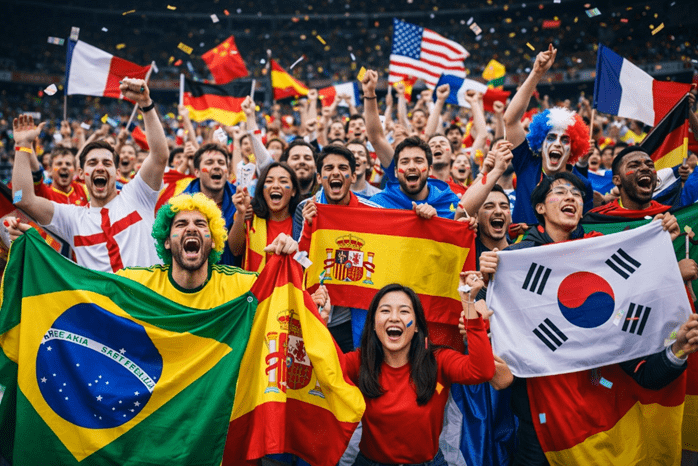
Sports translation enables international tournaments to become global spectacles, bringing people from different cultures and backgrounds together. For example, at events such as the FIFA World Cup, fans from around the world come together to share their passion for the sport, despite speaking different languages.
Sports translation enables audiences around the world to follow the same matches, teams and stories in real time, whether through official broadcasts or social media posts. In this way, sports translation plays a vital role in breaking down cultural and linguistic barriers, turning soccer into a truly global experience.
The global reach of soccer
Sports translation is essential for expanding the global reach of soccer. International tournaments attract viewers from all over the world, creating a high demand for multilingual media content. As a result, international soccer events become more accessible, thus reinforcing the sport’s position as one of the most globalized.
Cultural differences in language and sports translation
The translation of sports terminology is complex and dynamic because sports terms are described differently across languages. Distinct expressions, tones and styles are used when discussing sport, reflecting supporters’ unique understanding of and experience of soccer. The same applies in stadiums, where supporters have unique songs and chants during matches that are difficult to translate convey into other languages. For this reason, sports translation often requires adaptation rather than direct translation.
In the context of English football, for instance, if a team has not conceded a goal to the opposing team, the term “clean sheet” is used. Notably, British English speakers do not use the standard English term ‘zero’, but instead use ‘nil’, which is defined as ‘nothing’.
Sports translation in real-time contexts
Real-time sports translation is one of the most demanding aspects of global sports communication. Live broadcasts, press conferences and post-match interviews require immediate translation and interpretation, often under considerable time pressure. Translators and interpreters must work quickly and accurately to convey information without delay and keep audiences connected to the event. According to the official FIFA document, the four official languages are: English, French, German and Spanish. This means that the majority of communications and information must be presented in these languages.
The FIFA Language Services Department is responsible for translating a variety of documents, including regulations, technical reports, medical and anti-doping information, and legal documents. They are all considered to be part of the official documentation. While translators are primarily responsible for these tasks, interpreters also play a role at events. For these professionals, FIFA provides simultaneous interpretation in designated booths for high-level meetings and the FIFA Congress, and uses consecutive interpretation for informal settings such as interviews, mixed zones and on-field interviews.
For further insight into sport specialist, you can explore this related article.
The social impact of translation in internationals sport events
Sports translation is not just a technical process; it also plays a vital social role at global sporting events. By facilitating communication across languages, sports translation enables audiences from different linguistic and cultural backgrounds to access the same content. This reduces communication barriers and promotes inclusion. It enables more people to engage with global events such as the FIFA World Cup, regardless of their language. For more knowledge insights, you can also watch this overview video.
Why professional sports translation services matter
Machine translation tools can help with simple phrases. However, they often fail to capture idiomatic expressions and industry-specific terminology.
Professional sports translation services ensure:
- Real-time communication support
- Contextual meaning preservation
- International media reach
- Accurate, consistent communication
Here at LingoStar, we provide a range of professional sports language services, including editing, translation and interpretation. Our work helps global audiences understand and enjoy multilingual content. Our services are particularly useful for sports videos, sports documentaries, interviews with athletes and fans, and other sports-related audiovisual materials.
Feel free to download our free multilingual translation e-book to find out how translation can help expand your online presence.
Our services are particularly valuable for subtitling, translation, and voice-over in sports-related audiovisual content, enhancing accessibility and audience engagement. Interpretation services are currently offered exclusively in Canada.
Sign up for our newsletter to receive valuable insights about cultures, languages and translation.

Would you like to stay updated on the latest news from the translation industry? Follow us on social media (Instagram, Facebook, X, YouTube and LinkedIn), explore our other blog posts, and don’t forget to subscribe to our newsletter to join our community!
Explore our ebooks about multilingual translations: